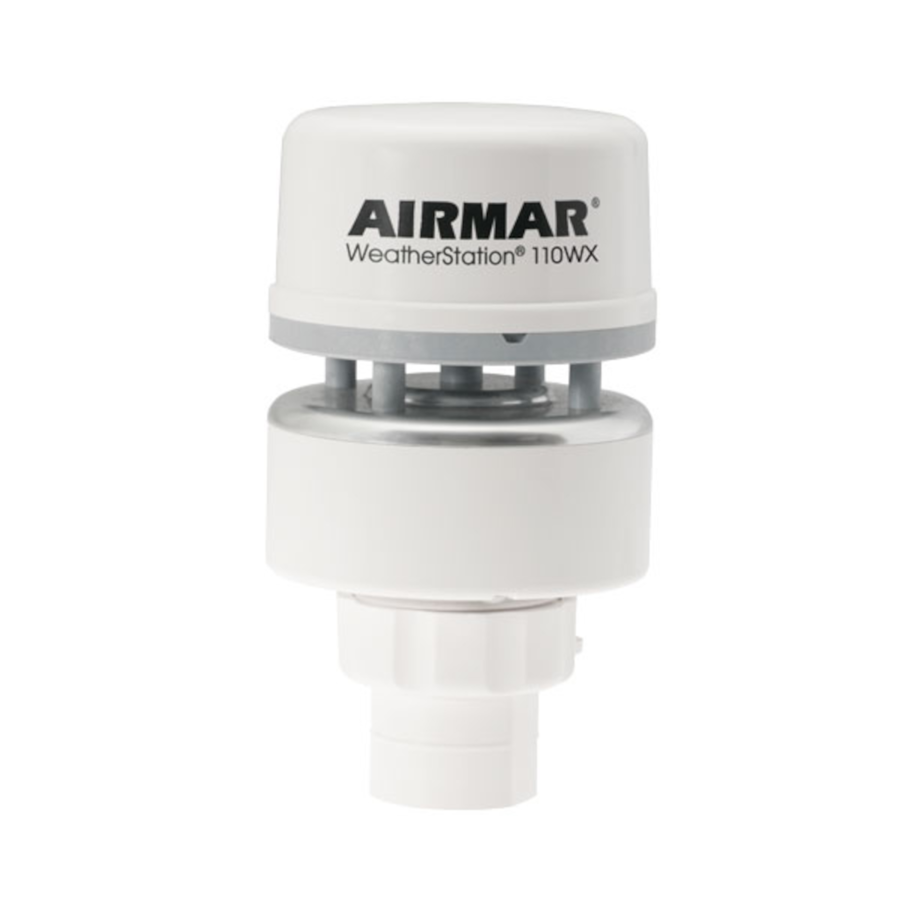
Airmar WeatherStation Guide: Real-Time Weather Data for Your Boat

A chartplotter shows you where you are. An Airmar WeatherStation tells you what the weather is doing right now — at your exact location, updated continuously. Wind speed, wind direction, barometric pressure, air temperature, compass heading, pitch, and roll, all from a single sensor on your T-top or mast. For offshore cruisers, sailors, and serious fishermen, it's one of the most useful instruments on the boat.
What Does an Airmar WeatherStation Measure?
Depending on the model, an Airmar WeatherStation provides some or all of the following:
- Wind speed and direction – True wind calculated from apparent wind + vessel speed + heading
- Barometric pressure and trend – Rising or falling, with configurable alarm thresholds
- Air temperature
- Relative humidity and dew point (select models)
- Compass heading, pitch, and roll – From integrated solid-state sensors
- GPS position and speed (select models)
All of this feeds to your chartplotter, navigation software, or dedicated display via NMEA 0183 and/or NMEA 2000 — the same data protocols your electronics already use.
Cup Anemometer vs. Ultrasonic Wind Sensing
Lower-end WeatherStation models use a traditional cup anemometer — a spinning wheel that measures wind speed mechanically. They work well in moderate and strong winds but under-read in light air (below 5 knots) and require periodic bearing replacement over years of use.
Ultrasonic models (150WX, 200WX, and up) measure wind speed and direction using sound waves — no moving parts, zero mechanical wear, and accurate even in light air. For sailors and bluewater cruisers, ultrasonic is worth the premium. For powerboaters primarily interested in squall detection and pressure trend, a cup anemometer model performs fine.
NMEA 0183 vs. NMEA 2000 Output
Most Airmar WeatherStation models output NMEA 0183 and/or NMEA 2000. The right choice depends on your boat's network:
- NMEA 0183 – Point-to-point serial connection. Older standard but universally supported. Each device connects via a dedicated cable run.
- NMEA 2000 (N2K) – Backbone network. Plug in anywhere on the backbone and all connected devices receive the data. Much cleaner for modern boats with multiple electronics.
If your boat has an NMEA 2000 backbone (most new boats with Garmin, Simrad, Raymarine, or Furuno electronics do), the 120WX NMEA 2000 version is the cleanest installation. If you need compatibility with an older display or PC navigation software, an NMEA 0183 output model is more flexible.
Relative Humidity — Do You Need It?
Models with the "-RH" suffix include a relative humidity sensor that enables dew point and heat index calculations. For offshore sailors doing coastal and bluewater passages, dew point is a useful fog prediction indicator. For powerboat fishermen, it's a nice-to-have but not essential. The upgrade cost is typically modest — worth it if you spend extended time offshore.
The Heated Option (220WX-HTR)
Cold-climate boaters — Great Lakes, Pacific Northwest, New England offshore — should consider the heated WeatherStation models. Ice and frost accumulation on the sensor housing will disable an unheated unit. The heater option activates automatically in cold conditions and keeps the sensor accurate year-round.
Airmar WeatherStation Models Compared
| Model | Wind Type | Humidity | Output | Heater | Best For |
|---|---|---|---|---|---|
| 110WX | Cup | No | N0183+N2K | No | Powerboat, offshore squall monitoring |
| 110WX-RH | Cup | Yes | N0183+N2K | No | Offshore cruising, dew point awareness |
| 120WX | Cup | No | N2K only | No | Modern N2K backbone, clean install |
| 150WX | Ultrasonic | No | N0183+N2K | No | Sailors, light-air accuracy |
| 200WX | Ultrasonic | No | Standalone | No | Standalone display, no chartplotter |
| 220WX | Ultrasonic | Yes | N0183 | Available | Cold-climate, full sensor suite |
Our WeatherStation Picks
Airmar 110WX NMEA 0183 / 2000® WeatherStation® - (No Relative Humidity) - RS422
SKU: AIR-WS-110WX | More Info
The entry-level 110WX packs wind speed, wind direction, barometric pressure, air temperature, compass heading, pitch, and roll into a single compact unit with NMEA 0183 and NMEA 2000 output. Mounts at the masthead or T-top — one cable, full weather data.
Airmar 110WX NMEA 0183 / 2000® WeatherStation® - Relative Humidity - RS422
SKU: AIR-WS-110WX-RH | More Info
The 110WX with relative humidity adds dew point and heat index calculations to the base 110WX sensor suite. RS422 output makes it compatible with a wider range of chart plotters and display systems. For offshore passages where full environmental awareness matters.
Airmar 150WX NMEA 0183 / 2000® WeatherStation® - (No Relative Humidity)
SKU: AIR-WS-150WX | More Info
The 120WX offers the same sensor package as the 110WX but in a simplified NMEA 2000-only configuration. Plug directly into your NMEA 2000 backbone — no separate power supply or interface box needed. Clean installation for boats already running N2K.
Airmar 200WX WeatherStation® Instrument - Land-based, Mobile, Standalone
SKU: AIR-WS-200WX | More Info
The 150WX steps up to ultrasonic wind sensing — no moving parts, which means no mechanical wear and no calibration over time. More accurate wind data at low speeds and in light air where cup anemometers under-read. The right choice for sailors and anyone who depends on precise wind for navigation.
Airmar 220WX NMEA 0183 WeatherStation® - (No Relative Humidity) - RS232 - Heater
SKU: AIR-WS-220WX | More Info
The 200WX is Airmar's standalone WeatherStation — designed for land-based deployment, mobile applications, and vessels that need an independent weather display without tying into a chartplotter network. Outputs to a standalone Airmar display or PC. Includes barometric pressure, air temperature, wind speed/direction, compass, pitch, and roll.
🌊 Expert Advice from Mack Jennings
The most underrated instrument on any offshore boat. People spend thousands on fishfinders and chartplotters, but they're still checking the weather on their phone. Your phone weather is from a station 50 miles away and hours old. An Airmar WeatherStation gives you the barometric pressure trend right now, at your location. A rapid 3-millibar drop in 3 hours is not something you want to miss offshore.
For powerboat fishermen, the 110WX is usually all you need. For sailors and bluewater cruisers, spend the extra money for the 150WX ultrasonic model — the accuracy in light air is significantly better and there are no bearings to service. If you're in New England or the Great Lakes, get the heated version for winter operation.
Installation is straightforward: mount at the masthead or T-top, run the cable, connect to your chartplotter or N2K backbone, and configure the display sentences. We can install and configure at our Stevensville, MD shop. Email [email protected] with questions or to get a quote.
BOE Marine installs at 4 locations: Annapolis MD, Fort Lauderdale FL, Stuart FL, and Lake Norman NC. Lifetime tech support included.